

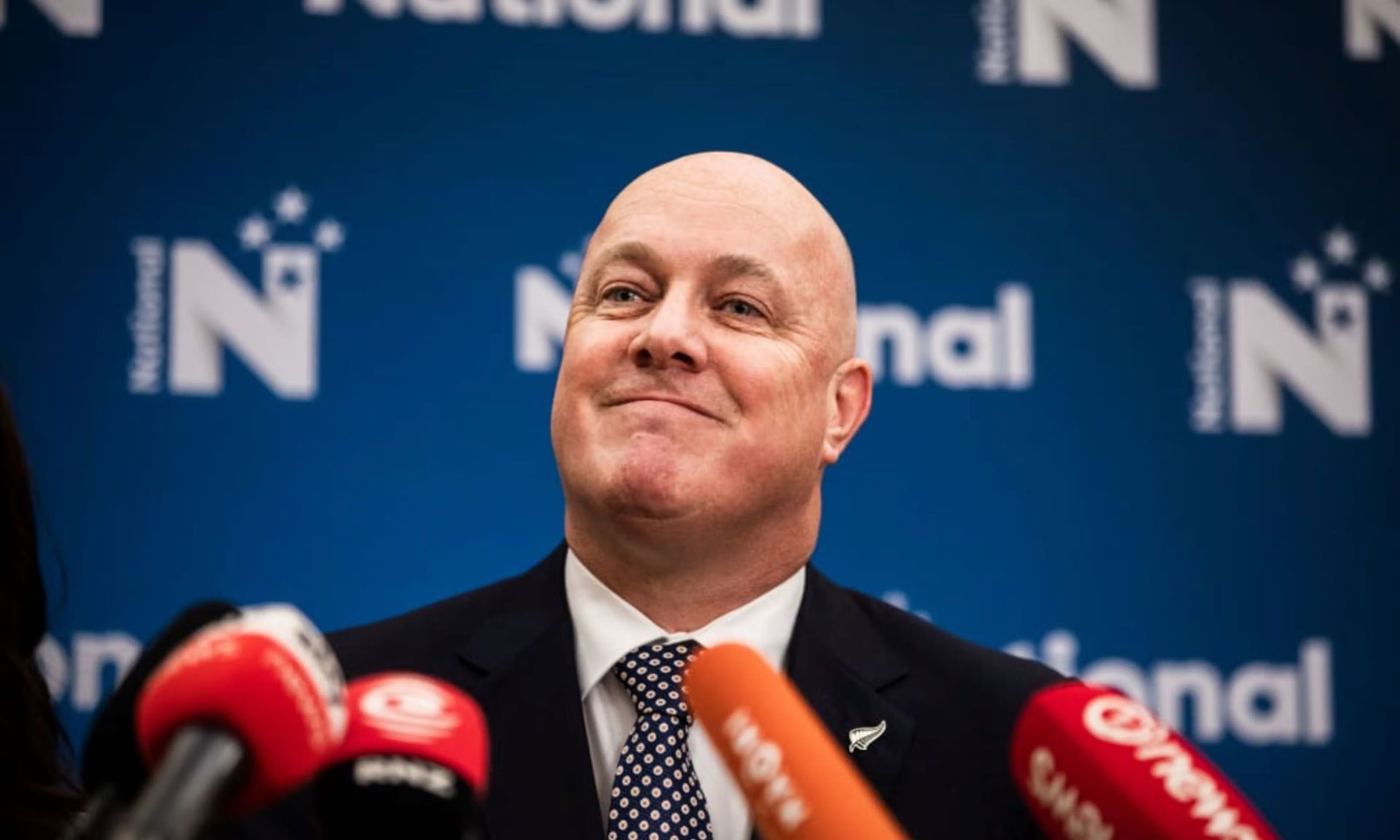
Spare a thought for poor old Christopher Luxon. I know, it’s not over yet. But even if he wins, which now looks less likely by the day, he’s still going to lose. We’re watching a man’s best-laid plans fall to bits in front of him. In front of us. It’s never pleasant.
Luxon thought Chris Hipkins was the enemy. And then it was Qiulae Wong. And now it’s Chlöe Swarbrick. But his real enemies are on the right. His own side.
The people wrecking his chances of heading up a credible National-led government are Don Brash, the Mowbray family, Winston Peters, David Seymour and the far-right provocateurs of Reality Check Radio. And Simeon Brown.
Brown excepted, these guys are all conspiring, through an extremely well-funded “overhang” campaign, to return a right-wing government whose principal features, if it comes to pass, will be 1) a weak and deeply wounded National Party, 2) a pair of resurgent, experienced and very determined “allies”, and 3) a coalition comprising three party leaders who all hate and mistrust each other.
None of these erstwhile “friends” of National is doing this to help National. Brash and the Mowbrays are in it because they’re terrified of Labour. (Why? More on this below.) Act and NZ First want their own programmes to dominate the next government.
Five thoughts about the overhang and National’s campaign …
1. Simeon’s hole
And how is Simeon Brown dragging his party down? When Luxon chose him as National’s election campaign manager, he rejected the incumbent, Chris Bishop.
In effect, he rejected a Bishop-style campaign that likely would have focused on the promise of “Fixing the basics, building the future”.
It’s a good slogan and it encapsulates everything Luxon thinks he’s doing in government. You don’t have to believe they’ve done well or support their policies (and mostly, I don’t) to recognise that, by their own lights, it defines a busy work programme. Notably, through the efforts of Erica Stanford in education, Nicola Willis in finance, Todd McClay in agriculture and trade, and Bishop himself in housing and resource management.
There are achievements they can look back on and aspirations they can look forward to. They’ve got a lot done; they have plans for much more.
But Luxon didn’t want Bishop in charge, so he promoted Brown instead: a fellow east-Auckland Christian conservative who shares Luxon’s fatal belief that most of us are enraged by progressive ideas. So while “fixing the basics, building the future” remained the official slogan, for the most part it’s lain dormant. Instead, Brown’s campaign has focused on fearmongering: about Labour’s supposed secret tax plans, about Jacinda Ardern’s record, about gangs and, really weirdly, about Chlöe Swarbrick.
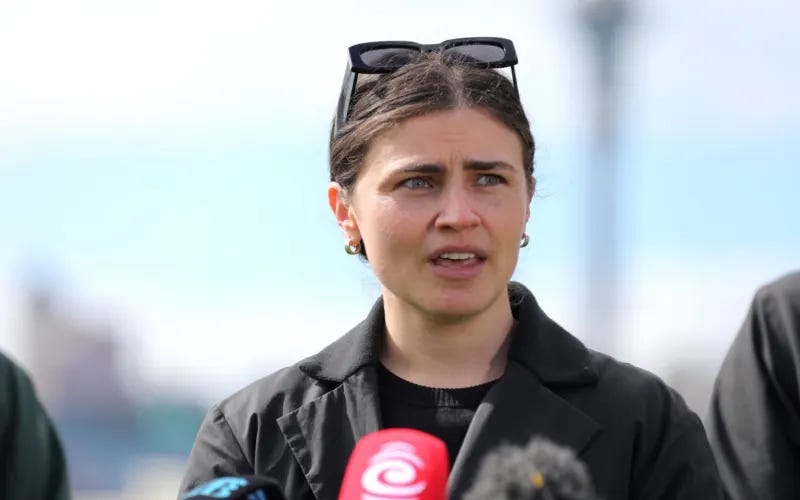
I suspect if someone were to line up all the people and policies and actions of the Greens over the last couple of years, and asked us to rate their scariness, Swarbrick would be the least scary – aka most popular – item on the list. People like her.
None of Brown’s plan has worked. National is falling out of the race. Meanwhile, the other parties, each in its own way, have offered a bit of hope for some relief right now and for a stronger, better future to come. This is what they’ve campaigned on and the polls suggest this is what voters want to hear. Who would have thought.
There wouldn’t even be a desperate attempt by National’s own “supporters” to engineer an overhang, if Brown hadn’t dug this hole for his own party. If Luxon hadn’t given him the keys to the digger.
And yet, it’s quite possible that after this election Simeon Brown could end up the most powerful person in the National Party. Because, shorn of experience, hobbled by the other coalition parties if they’re in power, and quite possibly not in power at all, that caucus will not be kind to Luxon.
2. Why can’t Luxon hear Opportunity knocking?
Refusing to talk to Opportunity could turn out to be the most tin-eared thing Luxon has done in his whole time in politics.
(It’s not like there isn’t any competition, from sneering at “bottom feeders” to enthusing about Trump’s attack on Iran, to telling small businesses to toughen up … the list is long.)
In his defence, he knows that if he had said he’d pick up the phone to Qiulae Wong, he could have triggered a wholesale desertion of National voters to Opportunity.
But that’s on him. If he hadn’t done so much to reposition National away from the centre and more on the right, those voters wouldn’t feel the pull of Opportunity. You’d think he might have worked this out some time ago: perhaps before he chose Simeon Brown instead of Chris Bishop to run the campaign … see above.
Now Luxon’s passed on Opportunity, he’s in a hole with those moderate centrist voters and this time he dug the whole thing himself. What he’s told them, loud and clear, is that he prefers Winston Peters and his crackpot culture wars, racism, climate denial and angry, unreliable ego, to Wong’s reasonable request that they find sensible common ground on which the country can move forward.

What’s in Luxon’s head that led him to that choice?
3. Dirty Don
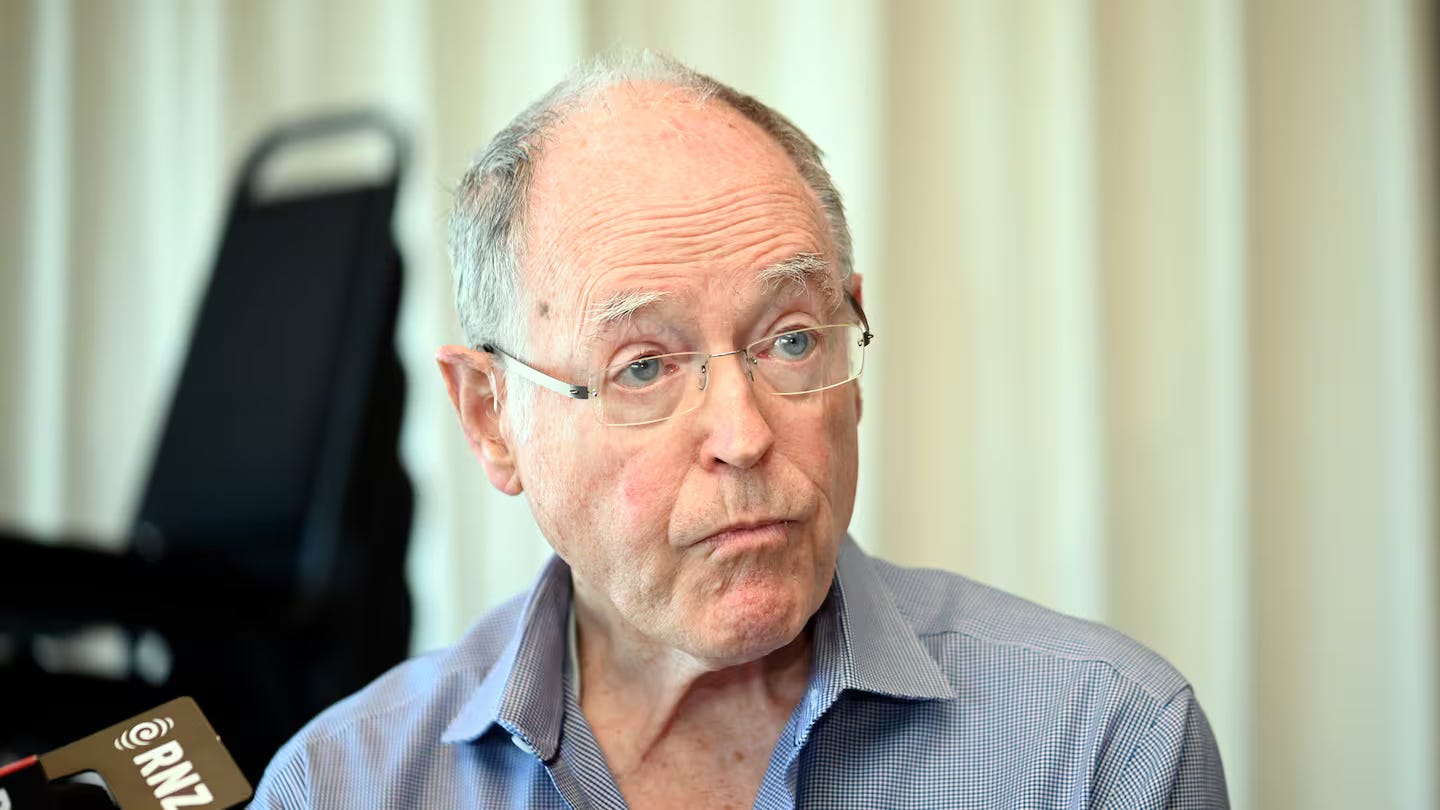
These days, overhang advocate Don Brash is a trustee of the racist Hobson’s Pledge, which he founded. He’s a former leader of both National and Act and, as Nicky Hager revealed in his book Dirty Work, has been a mentor to Jordan Williams at the Taxpayers Union (TU). I wrote about that here.
As Tim Murphy at Newsroom has reminded us, Brash has form when it comes to really big, privately funded attacks on an election. He supported the Exclusive Brethren’s covert campaign in 2005, when the church spent $1.2 million trying to keep Labour and the Greens out of power. Brash denied any knowledge of it, until the truth was revealed 10 days before election day.
That spending wasn’t illegal, but it was so unsavoury that parliament passed a new law in 2007 to prevent third parties secretly running or funding election campaigns.
It’s worth remembering what else Brash did. As National leader in 2005, he was responsible for the notorious “Iwi/Kiwi” advertising campaign, the culmination of years of anti-Māori rhetoric by Brash and others.
Short recap. In 1999 the incoming Labour government of Helen Clark established a policy called Closing the Gaps: an attempt to address the reasons Māori and Pacific peoples are statistically worse off than others in health, education and other areas. The blowback was fierce and the policy was dropped, although Brash campaigned against it anyway, with an inflammatory speech about “Māori privilege” in 2004 that led into the election campaign of 2005.
Meanwhile, in 2003, the Court of Appeal ruled that the Māori Land Court could hear claims to Māori customary title over parts of the foreshore and seabed. Many people interpreted this to mean the beaches might not remain as public spaces, so Labour shut down this possibility with the Foreshore and Seabed Bill, which vested full legal ownership in the Crown.
The bill was passed, but the removal of customary title led to a giant hīkoi to parliament in 2004 and split the Labour Party: Tariana Turia left to form the new Māori Party (now Te Pāti Māori), and the divisions are still alive today.
Brash’s “Iwi/Kiwi” campaign was a perverse and cynical response. It suggested Labour was working for Māori against the interests of other New Zealanders, even though the new law and the whole protest movement it generated were explicit proof the opposite was true: iwi felt betrayed by Labour.

It was National under John Key that resolved the issue, at least partly, with a new law in 2011, supported by the Māori Party, that established a “no ownership” regime and allowed iwi and hapū to seek customary marine title. A pretty good example of a partnership approach that works, from a time when National was not determined to inflame racial division at every turn.
But Brash was. He set up Hobson’s Pledge in 2016 and, as Hager’s book shows, he is one of the people who turned the 3 Waters issue into a race-based campaign in the 2023 election.
Now Brash is a leader of the overhang campaign. He’s deliberately trying to trash National’s party vote, so it wins more electorate seats than its party vote will entitle it to. If this happens, the party will keep the extra seats, making the parliament a bit larger, or giving it an “overhang”, and making it easier for the right to form a government.
To be clear, Brash and his co-conspirators are trying to engineer an outcome for National where getting fewer votes overall will produce more seats in parliament.
I can’t think of a single other New Zealander who has done as much as Don Brash this century to undermine democracy, confuse voters, stoke fear and social division, or weaponise racial hatred as a means to those ends.
4. A pox on them both
Overhangs are anti-democratic. The great strength of MMP is that it attempts to deliver a result where the proportion of seats each party gains in parliament matches the proportion of votes they got in the election. Overhangs distort this.
Te Pāti Māori is trying for an overhang on the left, which is wrong for the same reasons. But at least they’re not spending large amounts of money on it.
One of the things that has become clear about the overhang campaign is that it’s very unclear. It’s deeply confusing. But I suspect this confusion is deliberate. It undermines confidence in the democratic process.
5. What the overhang campaign is really about
The Mowbray family are the wealthiest New Zealanders on the planet, having made their billions selling Chinese-manufactured junk plastic toys into America. The Mowbrays are closely involved with the overhang campaign, even though Nick Mowbray claims to be the top donor to the National Party. He’s also given substantial sums to Act. Nick is well-known on social media for his support of the British far-right agitator Tommy Robinson and the American conspiracist Alex Jones. His personal views are well to the right of National’s.
Nick’s father Harry Mowbray is one of the public faces of the overhang campaign and has been open about his motives. He wants to discredit MMP, which he calls “a complete dog”. He doesn’t seem to mind discrediting the entire democratic process along with it.
The Mowbrays, along with Brash, Seymour, Peters and Reality Check Radio (RCR), want to keep Labour out of power.
RCR is a haven for anti-vaxxers, racists, misogynists, climate denialists and other far-right conspiracists. It’s been a voice for grievance, an amplifier of hatred against Jacinda Ardern and a platform for culture war.
Why do all these people and groups think it’s okay to rort the democratic process? What’s so frightening about Labour? It’s a moderate centre-left party with a moderate leader. What are they so scared of?
The answer is: Losing a little bit of their privilege.
In my view, the fundamental difference between the two sides in politics is that the right wants to reinforce privilege, while the left wants to restrain it.
Privilege is the reward for wealth. The argument for it is that wealth is necessary for entrepreneurial risk taking, which builds economies, which benefits everyone. To a degree these things are true.
The counterargument is that the benefits actually don’t flow to everyone. The extent to which they do is determined almost entirely by tax and regulations. For example, one of the benefits of a prosperous economy might be a well-functioning public health system, but this requires enough tax to pay for it.
Few on the right want an economic jungle, just as few on the left want a revolution. We use elections, and many other mechanisms, to decide where between those two extremes we will try to build a workable compromise.
Surveys consistently show that most of us want healthcare we can rely on, jobs and reasonable incomes, more climate action, an end to child poverty, clean water, environmental restraints on property development, partnerships with iwi. They also show that two thirds of us accept these things require equitable tax reform.
To put that in real terms, we think it’s wrong that the cleaner, the tradie, the sales assistant, the office worker and the pool guy all pay more than twice the rate of tax as the people who own the mansions and the tower blocks where they work. For the record, as I reported last week, the Mowbrays and another 300 megawealthy New Zealand families pay, on average, an effective tax rate of 8.1% on their incomes. The median rate is 17.4%.
This is what the overhang campaign is really about. Preserving their privilege, so they don’t have to pay more tax.
If they succeed, we’ll get a government in which the leading voices are likely to be David Seymour, Winston Peters, Simeon Brown and Shane Jones. It will be dysfunctional, with National in disarray and all three parties at each other’s throats.
But it will not reform tax. It will preserve, intact, the privilege of people who think they can buy elections.
And the good news, the hopeful note? There’s some for us, but not a lot for Luxon. TVNZ’s Verian poll on Tuesday night suggests the overhang campaign is not working and the government may lose the election. Don’t forget to vote.
Hopetown: A lament for Christopher Luxon
Thanks for reading this far. I like to think of Hopetown as a place to celebrate the wonder of doing things differently and the possibility of doing them better, in music as in politics and all the rest. Here’s Marlon Williams with Florence + The Machine in a rockier version of the great, great song he originally recorded with Aldous Harding.
This one goes out to Christopher Luxon.
Terrific piece Simon - you’ve nailed it
So helpful to understand the forces at play and why nobody gets what they want anymore
Thank you for this timely situation report. I was reminded of Brash’s first foray into politics, when he stood as the National Party candidate in the East Coast Bays by-election during my first year at high school. At the ripe old age of 14 I was convinced that Rob Muldoon was the devil incarnate, so I was intrigued by Muldoon’s obvious sabotage of Brash’s candidacy in the “safe National seat” by doubling the Harbour Bridge tolls. It wasn’t until after Brash’s ascendency to Reserve Bank governor that I came to understand why Muldoon despised him so much. He is quite possibly the most odious figure in the Aotearoa political-economy milieu in the last 40 years—even exceeding Winston Peters.