

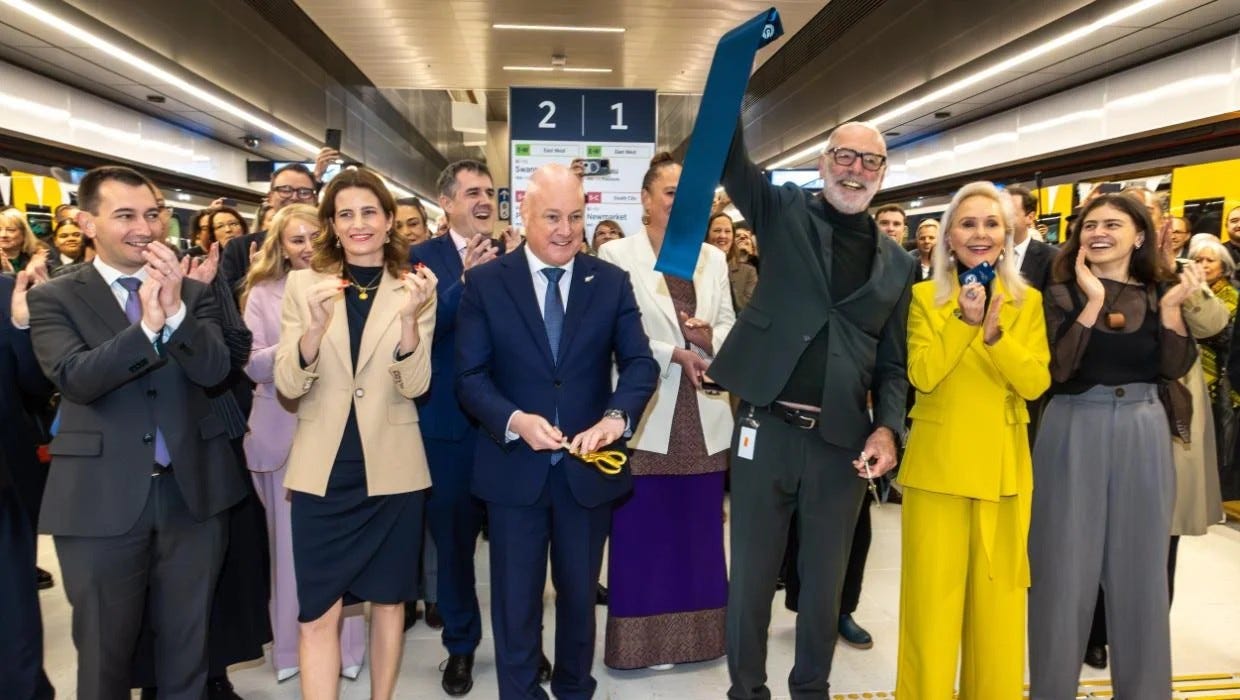
Guess who this is: The City Rail Link will mean fewer cars on the roads, more productivity, more time for people to spend with their families. It is so much more than a public transport project and will have economic benefits for decades to come.
That’s the PM, Christopher Luxon, speaking at the CRL launch on Friday morning.
People told me they thought his speech was robotic and dull, and in its delivery that was true. But I was delighted. Luxon told us he knew the value of the CRL. He understood that the key to addressing Auckland’s chronic inefficiency on the roads is to get more people out of their cars and onto public transport, and therefore PT has to be better.
He didn’t explicitly endorse the theory of induced demand (if you build more roads, more people will drive on them), although it is well-established. He didn’t mention that less driving also means fewer emissions and better road safety and public health. But he did grasp that the CRL will qualitatively improve the whole Auckland transport network, which is why it has enormous potential for the city.
In the media standup later, he kept saying everything was “incredible”, which can be irritating. But he also expanded on his central theme, talking about how people will find it easier to use the train not just for work but for going to restaurants and shows, engaging with the city more easily and in so many ways.
“We see people living like this all round the world,” he said. When Sir Dove-Myer Robinson said such things in the 1970s, few people were listening. Even 20 years ago it used to be only urbanists on the fringe who said it. Now it’s normal. This is what cities do. And Luxon has picked up on it.
The Overton Window has shifted. (This is the idea, conceived in the 1990s by policy analyst Joseph Overton, that in any debate there’s a frame around the ideas regarded as acceptable or mainstream, while others are excluded, but over time the frame, or window, is likely to change.) On public transport, though perhaps little else, Simeon Brown is no longer writing the government’s talking points.
What Wayne said
Luxon wasn’t the only speaker to surprise. Mayor Wayne Brown spoke generously about the first supercity mayor, Len Brown, saying he was “full of admiration for Len Brown getting this project past the government”. When Wayne came into office in 2022 he had nothing good to say about either of his predecessors, but he has since discovered how hard it is to bend the government to your will. And there was Len himself, in the front row, looking a little older but still with that beaming, determined positivity spread all over his face.
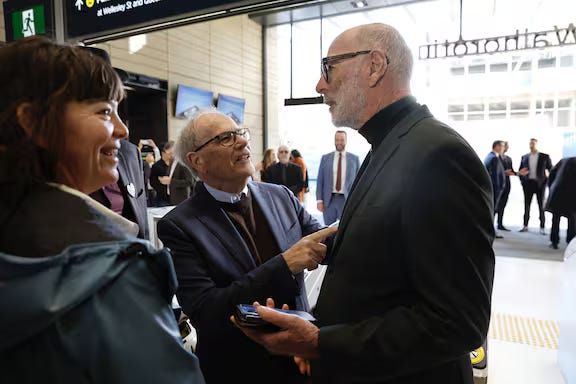
I wrote about his contribution recently in the Listener.
In addition to the “gratitude” he had for Len, Wayne spoke of his other “mixed emotions”, including relief that the CRL is finally open, “pride in Auckland becoming a modern city” and sympathy for the disrupted businesses during construction. Then he attacked the government, with Luxon, Nicola Willis, Chris Bishop, Simeon Brown and Winston Peters sitting right in front of him.
The CRL isn’t the only major transport project to have cost far too much, he said. The just-starting Warkworth to Te Hana highway (known as W2TH) was another: it now has an estimated $9 billion pricetag, according to analysis by Greater Auckland. Brown said, intriguingly: “That one might still be rescued.”
He complained, as he always does, about the stations being “cathedrals”, suggesting that Moscow doesn’t have big station entrances like the CRL. Bad example: most Moscow station entrances might be modest, but it long ago set a global benchmark for beautiful underground station design.
Brown also complained about the lack of progress on the vast empty site around the Maungawhau station, blaming “The weak efforts of Eke Panuku which is why they are no longer with us”. It’s true Eke Panuku, formerly the council’s “placemaking” agency, did not manage to get the site masterplanned or even ready for that, but the blame is far from theirs alone.
“It future-proofing really was important, railway crossings would have been in the budget.”
He’s disbanded the agency and folded its functions into a new Auckland Urban Development Office within the main council structure. New chief executive, but many of the same staff. (I’ll be writing about what went wrong at Maungawhau soon.)
Brown is critical that the CRL’s platforms are long enough for nine-carriage trains, which was done to “future proof” them. “It future-proofing really was important, railway crossings would have been in the budget.”
I think he’s wrong about the platforms but right about the crossings. KiwiRail and Auckland Transport have a list of 42 level crossings that may need changing, with options that include trenches, bridges and closure. The challenge is formidable.
What Winston said
Winston Peters, the minister for rail, did his best to steal the show, first by singing a bit of Johnny Cash and then by moaning about the stations having Te Reo names. “It’s not Waidemadda, it’s Britomart,” he said. “Now everyone has to learn a whole new set of names.”
It was a gratuitous, calculated insult to everyone involved in naming the stations, especially Ngāti Whātua Ōrākei, who were there in force.
“If five-year-olds can do it,” called out a guy near me, “so can you!”
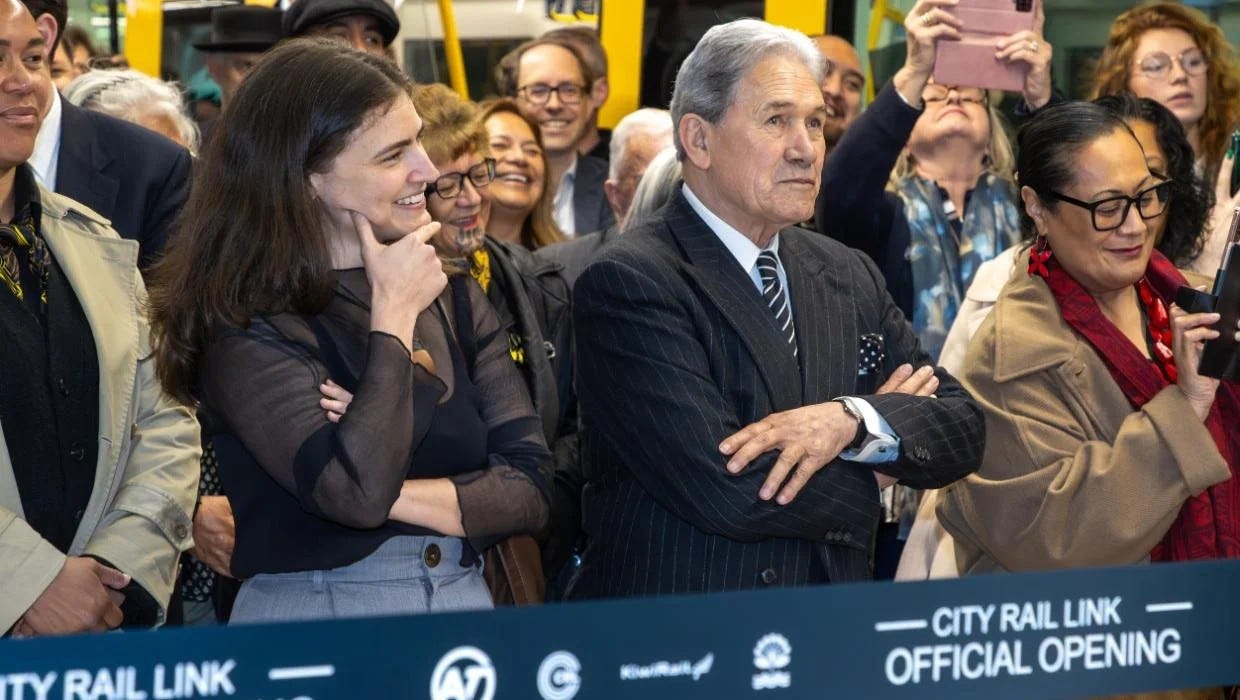
How Peters must have hated having to sit there and look at all the signs in Te Reo and English. (I assume he never actually catches a train or a bus in Auckland, because if he did he would surely have complained by now about all the intercom messages in Te Reo as well as English.) If he was hoping to get his boorishness onto the TV news that evening, he was out of luck. They didn’t indulge him.
He also said there should be an “Auckland Central” station, just as there are “London Central” and “New York Central” stations. Wrong on both counts.
How Winston Peters must have hated having to sit there and look at all the signs in Te Reo and English.
Peters referred continually in his speech to “we”: it was “we” who electrified the line to Pukekohe, added the third line to Wiri, added new stations in the south and rebuilt the whole network, he said. Did he mean “we the government” or “we NZ First”? Either way, none of those things would have happened without sustained and successful lobbying by the Auckland Regional Authority and later the Auckland Council. Just the same as the CRL.
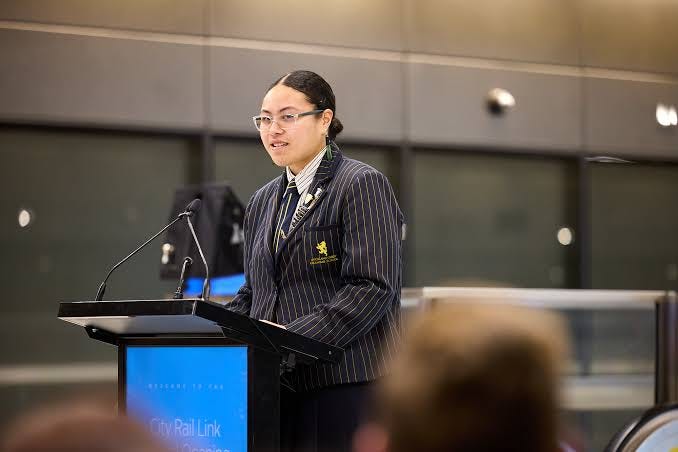
Last up was an assured and insightful speech by Ryvah Cooper, head girl at Auckland Girls’ Grammar School. She said 70% of her school’s students come from out of zone and the CRL will change their lives. Not only in their daily commute through the new Karanga-a-Hape station, but also in the way the school will more easily be able to connect to the museums and other amenities of the city.
Several people noted the quality of the speeches was inversely proportional to the age of the speaker.
Has the Overton Window really shifted?
The answer is yes. When the PM of a government closely aligned to car dependency starts talking about reducing car travel in order to manage road congestion, improve the lives of citizens and strengthen business, that’s a real change.
Does it also follow that National has accepted the reality of induced demand? The evidence is mixed.
Most of the Roads of National Significance have been shelved, with no apparent prospect of funding. That is, they’re cancelled, although this is not admitted. (I wrote about this recently in the Listener too.)
But the ones that remain were not selected because they’re the most valuable. They’ve survived merely because preliminary construction has started or is close. They include W2TH, which has no prospect of a good business case, and Cambridge to Piarere, just north of Tirau, which will also make no sense economically.
And if Luxon’s new grasp of the value of public transport was deep enough, there would be much stronger funding commitments to new rapid transit busways for Auckland, including in the northwest, Botany to the airport and a second line north of the bridge.
The new Auckland Regional Transport Committee, with joint membership nominated by the government and the council, will start work this month. High on its agenda: drawing up a 30-year strategic transport plan for the region. We shall see.
Channelling Chippie
Meanwhile, what’s Labour up to? Labour supports the CRL: the previous government kept construction going and provided extra funding when required, but the party wasn’t on the speakers’ list for the official opening and was represented only by deputy leader Carmel Sepuloni.
Some larger questions arise. What is Labour’s vision for the city? Does it have anything to contribute to the debate on how transport should grow? If the Overton Window has shifted, does Labour grasp this?
Who would know? Party leader Chris Hipkins has been determined to run a “small-target” campaign this election, seemingly intent on releasing as little policy as he thinks he can get away with.
That was plainly on show in Auckland last week when housing and infrastructure spokesperson Kieran McAnulty spoke to a conference of architects at the Aotea Centre.
His message: “The job of the Opposition is to provide as much certainty as possible.” He said those words.
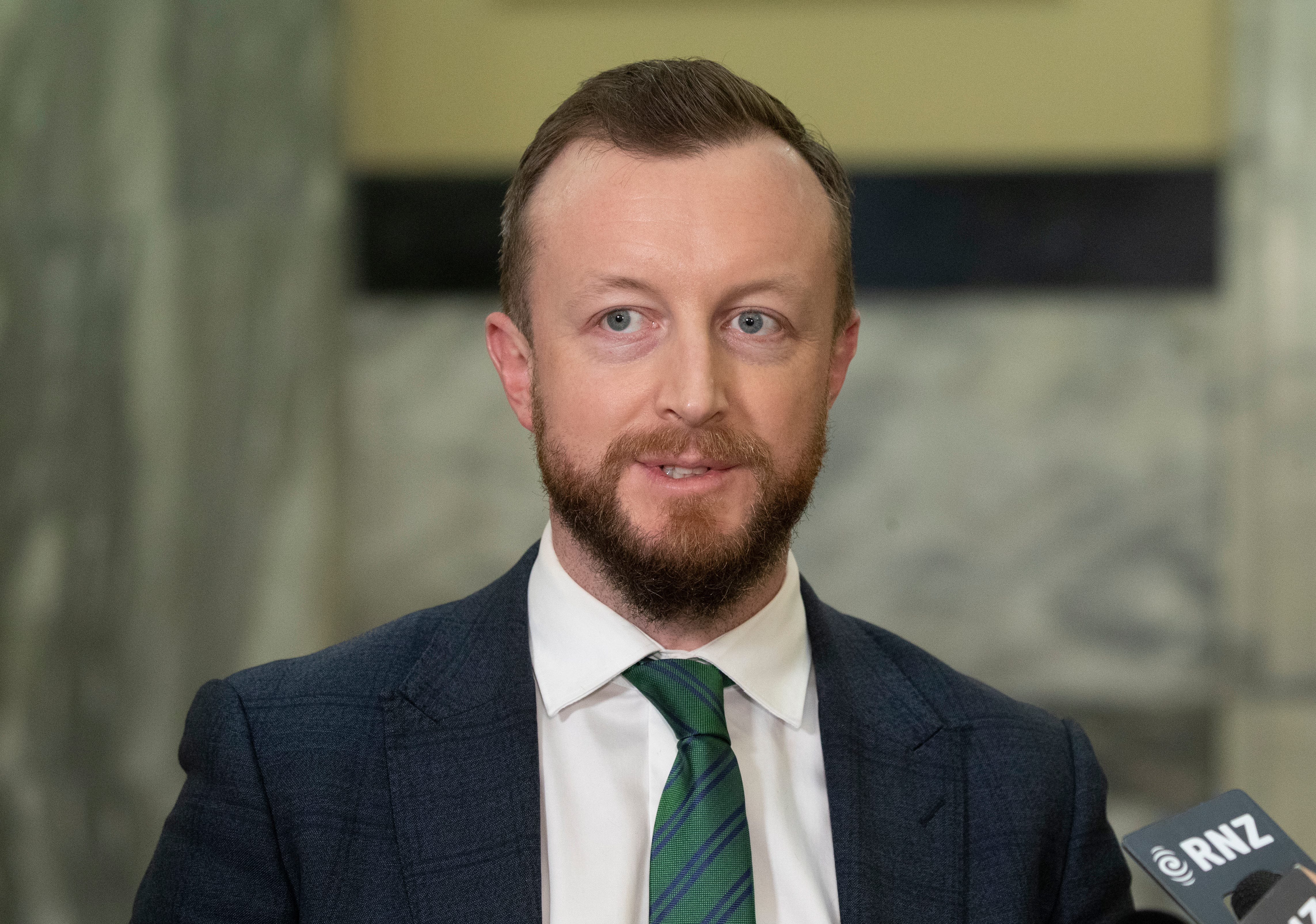
He explained, and I’m paraphrasing now, that this means Labour will not, on the whole, undo what National has done, except at the edges. Even if they don’t much like the programme. People deserve to know that the projects, plans and policy settings of the current government, especially where they’re already underway, will not be undone by the next.
Let’s stop right there. The job of the opposition is “to provide certainty”?
No it isn’t. The job of the opposition is to fill voters with confidence that things can be better. That they can fix what their opponents have broken and get better outcomes than the current lot, because they have a credible plan to do it. And look, here it is. It’s to make us believe in the value of change. To give us hope.
If all we wanted was more of the same, why wouldn’t we just vote National? How can “better starts now” be true if all they’re going to do is tweak the programmes that are making things worse?
This was McAnulty channelling Chippie, and it was depressing.
I get that it makes political sense to reassure “stakeholders” that long-term planning won’t be sabotaged with every change of government. But that shouldn’t be the central message. And it certainly shouldn’t mean Labour will accept every long-term plan its opponents put up.
How can “better starts now” be true if all they’re going to do is tweak the programmes that are making things worse?
Just a reminder: the government’s long-term plans waste billions on unproductive new roads. They imperil our energy security, abandon emissions reduction targets, sideline climate risks in resource management, largely ignore the need to plan climate resilience and in many other ways fail to acknowledge the climate crisis. They undermine local council planning and financial security. They have sabotaged school-curriculum reform and they leave us exposed to rapacious profiteering by banks, energy companies and supermarkets. And they have almost nothing to say about regulating or even understanding AI.
As for the building sector, the government has all but destroyed the state’s role as a social housing provider, and when it did this it crashed the construction industry. Kainga Ora needs rebuilding, not abandoning. The country needs turning around, not tweaking.
This wasn’t a tough crowd for McAnulty to sell a message of hope. The construction and urban design sectors are desperate to hear from politicians who want to regulate and empower their sectors more productively – and more responsibly.
McAnulty could have promised a better building code, with an enlightened approach to new construction methods and materials, energy efficiency and the consenting process. He could have promised to jumpstart the state-housing construction programme and brownfields developments instead of the greenfields sprawl we’re blighted with now.
He could have said how they will lure back some of the 20,000 construction workers who have left the country and how they will stop runaway construction inflation. He could have promised much better resource management rules and urban planning guidelines.
But he didn’t say any of these things because he couldn’t. Some of them might be Labour aspirations but none are Labour policy. When you’re channelling Chippie, there isn’t much you can say. In effect, McAnulty told the crowd Labour might leave in place many of the settings that have been so damaging.
The politics of urban development are changing, for good and bad, and as Luxon revealed on Friday, National is changing too. Is Labour? In housing, as in transport, we just don’t know what it intends to do.
I’ve put my allegiance on record about this before, but all I can say is, how good that the Greens do have housing, transport and other urban development policies, which do make sense, and which, if they get the chance in a new coalition, they will surely seek to implement.
Making every public-transport fare in New Zealand free would cost about $1.20 per person per week. That's the equivalent to just 3% of our current national land-transport programme.
Imagine if we redirected a fraction of what we spend expanding roads into frequent, reliable, free public transport...
Less congestion, lower household costs and less imported fuel. Perhaps it’s worth asking which investment gives us the better return and makes much better sense.
"The City Rail Link will mean fewer cars on the roads, more productivity, more time for people to spend with their families." Wow, truly - I never thought I would hear those words come out of Luxon's mouth. Next he will be telling us that induced demand is a real thing, and that bicycles are up to 80 times more energy-efficient than cars! (Could be useful info if petrol climbs to $4 a litre as some are predicting).