

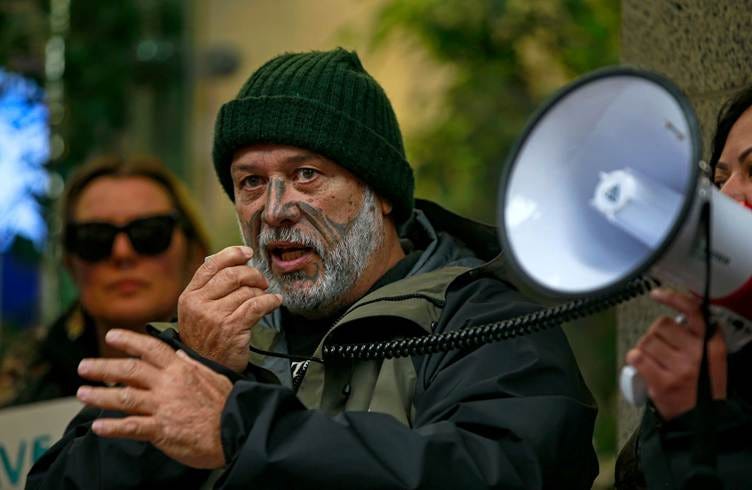
Mike Smith is not alone
Mike Smith is not alone. The activist who wants to take major carbon emitters in New Zealand to court for sabotaging our climate goals has many counterparts around the world.
In the US, a 20-year-old student called Eva Lighthiser and 22 other young Americans are locked in a legal battle to hold Donald Trump and his government to account for “boosting planet-warming fossil fuels”. Their case has been dismissed, but now they’re seeking reinstatement.
“We are challenging this administration for sacrificing the lives of myself and my fellow plaintiffs by expanding fossil fuels for the sake of power,” Lighthiser told supporters last month outside a courthouse in Portland, Oregon. She described the experience as “nerve-racking, but invigorating”.
“Eva v Trump” is just one of more than 1500 climate-related civil actions underway in America and there are hundreds more in other countries. We’ve had some ourselves, notably the case taken by law student Sarah Thomson in 2015 arguing the minister for climate change had not kept our 2050 emissions target in line with climate science. The high court agreed with Thomson that, in her words, “you can’t just set a target to reduce emissions and forget about it”. But although the minister “had acted unlawfully”, the court declined to order the government to review its position.
And Lawyers for Climate Action have a judicial review before the courts right now. They argue the minister has misused the Emissions Reduction Plan in relation to climate goals.

Let’s be clear. Legal action alone will not save the world. That’s going to take all kinds of action from all kinds of people. But Smith and Lighthiser are right that the big emitters, along with the politicians and others who protect them, should be the focus. They’re the ones responsible for the climate crisis and they have the most power to address it.
The aim is not only to succeed in law, although what a good thing that would be. It’s also, as Mike Smith has done brilliantly, to expose how those responsible for the crisis protect each other. Doing that is part of building the larger movement.
It’s not easy and as we’ve discovered from Smith’s case, they are capable of breaking the rules to defend their position. And of making tougher rules for everyone else: in Britain, environmental activists and Gaza protesters now face harsh penalties for some protest action, including lengthy jail terms for non-violent civil disobedience. The Guardian says this has created “a new class of political prisoner”.
An important aim, as Mike Smith has demonstrated brilliantly, is to expose how those responsible for the crisis protect each other. It’s part of building the larger movement.
A poem for the agents of doom
As Lynda Topp implied at the music awards last month, art may yet save us all. In the Parable novels, the late, great and extremely prescient Black American writer Octavia Butler envisaged a dystopian America ruled by a tyrannical president under the slogan “Make America Great Again”. The books, published in the 1990s, contain this poem, which our Defence Minister Chris Penk might like to study before his next encounter with Trump acolyte Pete “I love war” Hegseth.

I think I’ll send it to Substacker Anna Fifield, too. She reported Hegseth’s speech and Penk’s response at the Shangri-La Dialogue meeting in Singapore. Perhaps she could read it aloud next time she’s in a conference room with a Trumpian agent of doom.
Speaking truth to you know who: the People’s Emergency Briefing
In November 2025, an organisation in Britain called the National Emergency Briefing brought together leading experts to brief politicians and other influential people on the latest evidence on the climate crisis. Those briefings covered nature, the changing climate, health impacts, weather extremes. tipping points, food security, national security, economics and energy transition. Videos of each of the briefings are available here. There’s also a film, currently showing widely in Britain and available for hire.
The information in all this is focused on Britain, but a lot of it applies directly to us as well. The National Emergency Briefing is not a British government initiative, which is a shame, but something like it could be an official campaign here, couldn’t it?
With an election rushing towards us, there’s enormous scope for political parties to produce a decent strategy to deal with the climate crisis. At least some of them will want to show they take it seriously, won’t they?
A climate conference with no fossil-fuel lobbyists
If it wasn’t clear before, last year’s COP conference in Brazil drove home a terrible message: the fossil-fuel industries have taken over the UN’s diplomatic strategy for dealing with the climate crisis.
But that doesn’t mean they’ve won. In April, Colombia and the Netherlands convened the first Conference on Transitioning Away from Fossil Fuels, in the Colombian city of Santa Marta. Fifty-seven countries and the European Union showed up – that’s about half of all countries in the world – to find ways to “move decisively” past coal, oil and gas. And the fossil-fuel lobbyists were not welcome. Climate commentator Bill McKibben called it “a hinge moment for Planet Earth”.

The conference focused, as COP was supposed to have done in Glasgow in 2021, on the financing needed to transition to solar, wind and other renewables.
Despite Big Oil’s best efforts, things are changing. As the conference got underway, Donald Trump was busy destroying the credibility of the gas industry and America’s own military capacity to ensure safe passage for oil tankers.
China has reported that half of all vehicles sold in that country last year were EVs. The India Times revealed on May 1 that it isn’t all about giant SUVs, either: “Increasing penetration of EVs, especially two- and three-wheelers, and rapid deployment of Battery Electric Solar Systems across Southeast Asia and South Asia is now viewed as guaranteed by those in the industry.” The paper said that in the battery market, sourcing materials is now a bigger concern than generating demand for EVs and distributed solar systems.
The New Zealand government did not send energy minister Simeon Brown or anyone else to the Santa Marta conference. If it had, they would have heard UN envoy Selwin Hart tell the meeting: “Renewables offer something fossil fuels never did: stability and sovereignty. There are no embargoes, price shocks or tariffs.”
And yet Brown and co cling to their plan for an LNG terminal in New Plymouth, even as Qatar’s LNG export terminal lies in smoking ruins. Bloomberg has reported that India, Bangladesh, Thailand, Vietnam, the Philippines and other Asian nations are rethinking their interest in gas. No wonder the gas suppliers are so desperate to sell their product here.
The conference adopted a Fossil Fuel Treaty Initiative with three pillars.
First, a just transition to “fast track the adoption of renewable energy and economic diversification away from fossil fuels so that no worker, community or country is left behind”.
Second, non-proliferation, which means adopting a plan to “allow governments to stop building out the problem by ending the expansion of coal, oil and gas production”.
And third, a fair phase out among all the nations: “An equitable plan for the wind down of existing fossil-fuel production, where nations with the capacity and historical responsibility for emissions transition fastest, providing support to others around the world.”
Yes, we’ve heard all this before. But we do have to keep hearing it, we do need governments to agree and mean it, and if COP is to regain its credibility it should take notice. How about starting by locking the fossil-fuel lobbyists out of the room?
Just say no: the AI Resist List

When journalist and AI specialist Karen Hao was at the Auckland Writers Festival last month, she told her audience about a website soon to launch, dedicated to resisting everything bad about AI. Here it is: the AI Resist List.
I’m going to write more about this soon, but for now, here’s the preamble:
AI takes many forms. Like the word “transportation”, it refers to a collection of technologies as diverse and distinctive as bicycles to rockets. But today, one version of AI takes all the oxygen: large-scale, generative systems that power products like Claude, Gemini, and ChatGPT.
These systems consume an unfathomable amount of data, land, energy, labour and water. They are rooted in profoundly disturbing ideologies that seek to flatten the world into a “one size fits all” abstraction and to replace humans with machines.
We call the companies leading this form of AI development “empires”. Under the guise of a civilising mission to “benefit all of humanity”, they use large-scale AI development as cover to consolidate resources, destroy ecosystems, centralise information, hollow out institutions, and gain paramount economic and political power.
As for the Resist List itself, it’s organised under a few headings: call out the hype, follow the funders, take back our data, fight extractive data centres, combat resource extraction, advocate for the rights of workers, challenge permissive government, reject surveillance and just say no.
When communities care: dementia
How much can local communities do to look after their vulnerable members? Heaps. Here’s a tough, heartwarming reminder of what’s possible, from Three’s The Hui, from Wairoa in northern Hawke’s Bay. A town, like many others, where it must sometimes feel like everyone else forgot about them.
Power surge: the clean electric revolution
There’s good data to back up claims the world is going clean electric. The energy think tank Ember has reported a small but significant worldwide decline in fossil-fuel use for electricity in 2025. While demand for electricity grew by 850TWh (terawatt hours), solar and wind generation met most of that demand with 840TWh of new generation, while other renewables contributed 43TWh. Gas also grew, but the net output of coal, oil and gas was down by 41TWh.
This is pre-war data and it looks like a tipping point. Despite Trump, despite Simeon Brown.
Ten years ago, one gigawatt of additional solar energy was stored for every 56 generated. Now, the ratio is 1:4.
Two big things have made this possible. The first is the rise of affordable, efficient battery storage, especially for solar energy. Ten years ago, one gigawatt of additional solar energy was stored for every 56 generated. That’s not great for times when the sun don’t shine. Now, the ratio is 1:4.
The second is China. Last year, according to Bloomberg, the country accounted for 54% of new solar battery capacity. Yes, it’s still building coal plants, but China is way in front in the transition to renewables.
Buses doing the business
Greater Auckland has analysed the latest public transport data for the city, and the news is good.
Both February and March this year – before the fuel crisis – saw more people catching the bus than before Covid and the March figure of 7.5 million trips was the highest on record. The 12-month figure hasn’t topped 2019 yet, but Great Auckland says that on current trends, that should happen “later this year or early next year”.
Weekend bus use has been above pre-Covid levels for some time and now it’s climbed up to 24% above 2019. That’s more people realising that weekend trips don’t all need to be by car, and the fare structure should help: weekend fares are lower and children aged up to 15 travel free.
To nobody’s surprise, it hasn’t been such good news for rail. Disruptions to service caused by Kiwirail’s enormous maintenance and refurbishment programme have underminded confidence in rail services, but that work is supposedly nearing an end, prior to the CRL opening. The smart money appears to be on August.
Heaven at the Kennedy Centre
Art will always triumph? I like to think this clip is from the world we actually live in: it’s from a Led Zeppelin tribute at the Kennedy Centre in Washington DC, when the building stood for good stuff, long before Donald Trump pushed us into an alternate reality with his name carved illegally into the facade.
From left, in the clip, that’s Led Zep’s John Paul Jones, Robert Plant and Jimmy Page in the audience, with the performance of Stairway to Heaven featuring the Joyce Garrett Youth Choir, lead vocals by Ann Wilson, acoustic guitar by Nancy Wilson, both from Heart, drums by John Bonham’s son Jason and lead guitar by Shayne Fontaine.
Humanity, eh: it does the most amazing things.
I propose Mike Smith is our New Zealander of 2026 - a far better choice than Rod Drury, being yet another wealthy white privileged male who thinks he can behave as he sees fit.
Great update Simon- loving your voice on all these topics - thank you. 🙏