

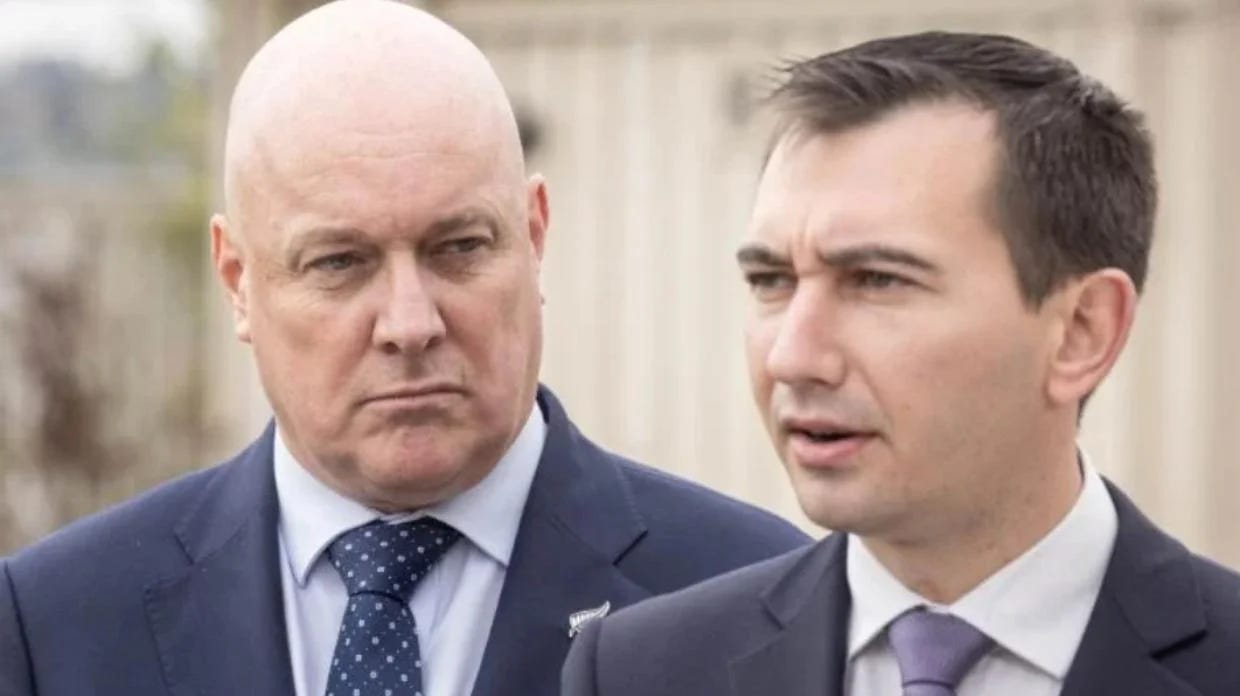
Health minister Simeon Brown presides over a health system riddled with scary bad indicators of failure. Among the things we’ve recently learned:
A seriously ill woman īn a rural South Island town was denied access to Dunedin Hospital by three different departments, who were too stretched to admit her, and later died of complications arising from her not receiving timely care.
A patient collapsed and died in an Emergency Department toilet at Waikato Hospital after waiting nine hours to be seen by a doctor.
On several occasions, children with cancer in Starship Hospital have been left in agony because no qualified nurses were available to refill their pain pumps.
In July, the North Shore Hospital ED was operating at “300% capacity”. Patients lay in soiled beds due to understaffing.
At Christchurch Hospital, the hallways became so full of patients on gurneys, they planned to set up emergency tents in the grounds.
The Australasian College for Emergency Medicine says EDs are now in “total crisis”.
Are voters allowed to have bottom lines? I don’t know about you, but this feels like one to me. I have spent my life under the assumption that if I or my children need hospital care, we will get it. I have assumed that same care is available to everyone. My parents assumed the same thing; in fact, until recently, I think we all assumed it.
If you need hospital care, you will get hospital care. It’s a fundamental tenet of our welfare state.
But it is no longer true. Not because of any event: there’s no pandemic, no earthquake or volcanic explosion that has exhausted the capacity of our hospitals. It’s because of neglect. Successive governments have not kept up with primary and public healthcare, or with medical advances, or with an ageing medical workforce, and these things have combined to push our healthcare system dangerously close to collapse.
I don’t know about you, but this feels like a bottom line to me. If you need hospital care, you will get hospital care. It’s a fundamental tenet of our welfare state.
Hospitals closed to some admissions. Hospitals where you might die just waiting to be seen. This isn’t us.
And the health minister has not been called to account. Nor, for that matter, have the finance minister, the prime minister, the entire cabinet. Even though we elect governments to ensure this does not happen.
Is it a plan?
It’s not sudden and it shouldn’t surprise anyone. These forces have been in play for years. But they have accelerated. Why? Because, long story short, under the John Key government, paying down the debt incurred during the global financial crisis meant health, like many other things, was chronically underfunded. Then came the Ardern government, which boosted funding and began to reorganise the sector, but the pandemic destroyed every hope and dream of that.
Now we have National again, and we’re back where we were. Paying down debt while people die in the ED toilet. This isn’t us.
I’ve been in the health system and I know how dedicated the staff are. They are heroes. Everyone knows this. But the government takes them for granted and meanwhile there have been more revelations.
Te Whatu Ora has been operating a hiring freeze. Both Brown and Christopher Luxon deny it, but data released under the Official Information Act reveals the net increase in fulltime equivalent nurses over the two years to March 2026 is only 54.
Palmerston North Hospital has no permanent gastro specialists, Nelson Hospital is down to one complex cancer surgeon and Southland Hospital is losing its last urologist. The Royal Australasian College of Physicians says NZ has just 44 practising specialists per 100,000 people, where Australia has 66.
Auckland Hospital has an infestation of cockroaches. At Middlemore Hospital, maternity wards have been “destroyed” by flea infestations and chronic ceiling leaks.
Poor internet security protocols have allowed a cyberattack on the Manage My Health portal to expose confidential medical records, and forced shutdowns of digital records in several hospitals, denying clinical staff access to patient data.
We wouldn’t have such a crisis in hospitals if primary healthcare had been looked after. But the Royal NZ College of General Practitioners says we have only 74 GPs per 100,000 people, and the ratio is getting worse. Australia has 116, Canada 122.
Much of this will take time to fix, but we also need emergency solutions now, and longer-term fixes will only happen if the government adopts a decent plan.
National says it is already spending more on health than any previous government, but that’s true every year, with every government, because of the growing population. Under National, health funding in real terms has gone backwards. Might it do better in a second term? Why would anyone think that? The record speaks for itself.
The Opportunity Party has called for “a 10-year, cross-party plan for health”, to include “the funding increases our healthcare workers need, and more investment in primary and preventative care to stop people from getting sick in the first place”. It’s one of their bottom lines. It’s simple and obvious and, to date, it has been beyond the current government to think like this.

Labour has promised three free GP visits, a job for all graduating nurses and several other measures. The Greens have proposed an extra $3 billion a year for health. None of this will fix everything, but it will make a difference. Especially that big whack of extra funding in the Greens’ plans.
Here’s an astonishing statistic, revealed last week: 80% of the coalition government’s new spending on health (through Health NZ and ACC) has been channelled directly to the private sector.
This includes support for venture capital buying GP practices, the letting of IT and other admin contracts, and the now-widespread practice of specialist procedures being outsourced to private clinics.
When National exhorts us to stick to the plan, what plan does it mean? That 80% statistic is a clue.
What sticking to the plan really means
Routing public funds to the private sector is a hallmark of this government, although it has never been campaigned on or endorsed by the public. I think Simeon Brown’s ability to channel so much health funding into private hands is a principal reason he is held in high regard by his boss. He’s delivering the plan.
He’s doing it in energy, too, where he is also minister. Siphoning off scarce government funds for a gas plant in Taranaki will serve no national interest at all, but the petrochemicals industry sure is keen on it. Why? Because “natural gas” is the strategic fuel they’re using globally to keep us all addicted to fossil fuels. I wrote more about that here.
The government knows it won’t win the argument if the subject is “privatisation”. So its solution is just to proceed anyway, without too many overt selloffs. All the while talking up the efficiency of the private sector, despite ample evidence to the contrary: you’d think the fraught and expensive PPP under which the Transmission Gully highway was built would give pause to anyone wanting to keep that option alive.
In addition to health and energy, the private sector is being enriched with public money, in schemes now underway or proposed, in: mining incursions on conservation land, early childhood education, water and other local government services, more PPPs for more new roads, selling off Kainga Ora land while state-led social-housing construction is abandoned, charter schools and fast-tracked housing developments even where there are no services.
The bedmate of privatisation is crony corruption.
It’s especially obvious in a slew of recent environmental measures, including: new resource management rules that will pay polluting landowners, holding agriculture out of the ETS, embedding gas, oil and coal more deeply in the economy.
And if the Waitangi Tribunal and its supporting legislation are eviscerated, as National’s partners are both keen to do, we will lose not only the principal barrier to the cultural and economic exploitation of tangata whenua, but a bulwark against the private sector’s exploitation of our natural resources.
I’m afraid it does get worse. The bedmate of privatisation is crony corruption. Our lobbying regulations are almost non-existent and National has rejected the call from the parties on the left to clean them up. And you can draw a direct line from many of the beneficiaries of relaxed regulations and government funding to the coalition parties’ big donors. National, Act and NZ First don’t seem keen to clean that up, either.
Is it really the economy, stupid?
Bill Clinton said it, although his adviser James Carvill said it first, and now “It’s the economy, stupid” is famous. It means if people think things are tough for them, they will vote out the government. How does that apply to this election, where everyone says the high cost of living is the big issue but the government responsible for it might be returned to power?
Does National’s plan, the one it wants us to stick to, even address the cost of living?
At the start of its term the government gave the Reserve Bank only one job: to hold inflation within a prescribed band of 1%-3%. But it’s failed. Inflation is above that band, at 3.7%, and will rise higher before the end of the year. Oil prices are pushing it up, but the government itself is responsible for how it responds to that pressure.
Noticed how Luxon and Nicola Willis constantly blame the Ardern/Hipkins government for inflation in 2021-2023, even though pandemic-related factors caused most of the price rises? Now they blame oil prices for inflation on their own watch. They can’t have it both ways: if National thinks Labour mismanaged the global economic pressures it faced, it must accept it has done the same.
Especially because it has had options. Despite the performative ranting of Shane Jones, the government has declined to intervene in any meaningful way in the profiteering of supermarkets, energy companies or banks. High prices and a depressed economy are the result.
As for oil price shocks, they are neither new nor infrequent and shouldn’t surprise anyone. The fact is, we need a government that will reduce our economy’s exposure to such instability. Obviously, that means reducing our dependence on fossil fuels. But National, Act and NZ First have conspired to increase that dependence. This, in late 2026, is what climate denialism looks like. Emissions remain high and the cost of living goes up. Why would we stick with this part of the plan?
And why would we stick with the rest of it? All sorts of measures expose their shortcomings. Company liquidations, for example, have risen by almost 80% during the last three years and are now at a record level.
Although Luxon and Willis rightly say investment in technology and innovation are essential to economic success, they’ve done almost nothing about it. We spend only 1.54% of GDP on research and development, against the OECD average of 2.8%.
Instead, Luxon told small and medium businesses in August they need to toughen up and stop behaving like children.
Unemployment in the June quarter was at 5.6%: that’s 171,000 people without a job. Since then, new data reveals 12% of 20- to 24-year-olds are unemployed and, shockingly, 25.3% of 15- to 19-year-olds. All up, 160,000 young people are either unemployed or underemployed. Ticking time bomb right there.
Not that having a job is necessarily the cure for poverty, as Luxon and Willis often claim. The working poor now comprise 54% of all people living in poverty, but many of them still have to leave their heaters off in winter, visit food banks and take on more debt, because their pay is so low. I wrote about this here.
During a campaign debate on TV, Luxon claimed the minimum wage has kept up with inflation. That is not true: on his watch, it’s risen by only $1.25. How did he not know that?
Holding minimum wages down creates more poverty, more hardship, more social failure, more crime … and it also reduces the spending power of the customers our small and medium businesses rely on to survive and prosper. It’s both cruel and stupid.
As for spending, the government has a $50 billion programme of infrastructure, largely roads, that does not align with the criteria established by the Infrastructure Commission or the projects in the National Infrastructure Plan.
That plan was set up by the government specifically to embed long-term bipartisan decision-making for long-term projects. But it recommends more spending on hospitals and road maintenance and does not endorse the government’s Roads of National Significance. So the government has ignored it, proposing instead to spend money on expensive roads that do not have viable business cases.
This isn’t a competent government with a plan to fix the economy. Its record, instead, is of economic mismanagement, privatisation by stealth, crony corruption, climate denial, expensive populist promises, abject incompetence in health and … a still-rising cost of living!
Let’s hear it for mainstream ideas
Wanting something different isn’t whacky. Despair at the government’s refusal to deal with the cost of living is a mainstream idea, and it’s not the only one. As I mentioned last week, better healthcare, bipartisan infrastructure planning, more climate action, anti-profiteering and anti-corruption measures are all mainstream ideas now. But the three parties of the coalition government reject them all because, “Who’s going to pay for it?”
Some of that ridiculous roads budget should pay for it. So should a bit of equitable tax reform. Updated data out this week: between 2021 and 2024, the 311 richest families in New Zealand paid an effective tax rate of 8.1% on their incomes. Median-income earners paid 17.4%: a rate more than twice as high. The deckhand on the superyacht pays a higher rate of tax than the owner.
If the wealthiest 1% paid as the same tax rate on their effective income as a middle-income New Zealander, the tax take would be about $7 billion a year higher. That this should happen is also a mainstream idea: surveys suggest two thirds of us want it done. But not the parties of the government.
Labour says better starts now. I don’t know if that’s true, but it could be and it better be. I do know there’s a better chance of it with a strong Green caucus, and probably with Opportunity there too.
I do know I would like, once more, to live in a country where we can be confident that if we need hospital care, we will get it. I’m voting for a party that understands this is a “basic” that has to be fixed.
Hopetown: Time for some joy!
Thanks for reading this far. I like to think of Hopetown as a place to celebrate the wonder of doing things differently and the possibility of doing them better, in music as in politics and all the rest.
Here’s a Hopetown mood setter for the final week of the campaign. Ode to Joy is the final movement in Beethoven’s Ninth Symphony, first performed in Vienna in 1824. It’s a hymn to universal brotherhood and much loved these days, although it’s always had its detractors. “The product of a deaf and ageing composer,” sighed one critic.
Beethoven was 53 when he finished it, and died three years later, aged 56. He insisted on conducting the premiere himself, which meant he “stood in front of a conductor’s stand and threw himself back and forth like a madman. At one moment he stretched to his full height, at the next he crouched down to the floor, he flailed about with his hands and feet as though he wanted to play all the instruments and sing all the chorus parts.” The real conductor, baton in hand, did his job standing nearby.
At a little under six minutes, this flash mob version contains only a quarter of the full movement, but pretty much all of its heart. It was recorded in 2012 in the Catalonian city of Sabadell, by members of a local orchestra and choir. Happy voting!
Thank you for an excellent analysis of the current situation Simon. People, ignore these facts at our peril. Any longer at this coalitions hands and the tipping point into privatisation will be reached. Better must start now.
One point missed is that if the National led coalition are voted back in they will take this as a mandate to proceed with wholesale privatisation. Luxon has stated this expressly. This alone should be good reason to vote for an alternative to this orchestrated clusterf**k of NZ's governing powerbrokers.